
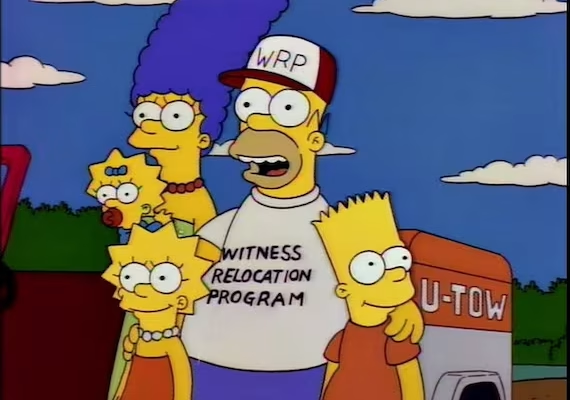
“And what if we picked the wrong religion? Every week we just make God madder and madder.“
Homer Simpson, “Homer the Heretic”
Dimethyltryptamine, otherwise known as DMT, is an extremely powerful hallucinogen that makes the experience of other pedestrian drugs seem like Instagram Reels to a Tarkovsky film. Some claim that there’s a shared dimension among DMT users inaccessible when sober, where similarly high individuals can interact with each other. Some discuss experiences of living thousands of years of inanimate objects – I knew a guy who claimed that he lived as a rock for a few millennia and was turned into a silicon wafer for a PS5, all in real time. The point stands that it sufficiently screws you up.
The reason I bring this up is the fact that there’s some evidence that the human brain endogenously produces DMT from the pineal gland near or at the moment of death. This evades any sort of well-defined physiological principle, but could potentially explain the frequent descriptions of life flashing before your eyes from those who go through near-death experiences. I’d like to think it’s the brain’s final act of grace when it recognizes that things are going to an irredeemable place. It’s better to go out listening to the Glenn Miller Orchestra and watching footage of cops beating up hippies than it is to the slow beep of a heart monitor and fluorescent overheads.
I couldn’t help but think about this fact throughout the majority of my Friday night spent at Duke Theater Department’s production of Anne Washburn’s Mr. Burns: A Post-Electric Play. Mr. Burns deals with pop culture the same way drunken relatives do two hours after Thanksgiving dinner should have come to a close—the words aren’t quite right, the impressions are deeply contextual, but you still get the idea.
What Mr. Burns is fundamentally about a group of people struggling to remember the past and then no longer struggling to remember what they remembered. Something cataclysmic has happened to the society that they know (explosions and fires are all that are mentioned as immediate causes), but it seems that the lingering after-effects are somewhat limited. The greatest hazard that these survivors face comes from each other – the usual post-apocalyptic trappings of parkas, pistols, and quibblings over non-perishables are all here, but with the added touch of the reading of those who have been lost.
A few performances especially rise to the top: Herrett, Klein, and Guo all deserve this particular critic’s warm accolades, with Guo’s monologue on a nuclear accident serving as the human climax of the play, the moment in which the apocalyptic setting feels most inaccessible in a manner that we can relate to. I anticipate that the majority of criticisms for this production will either be that it was too confusing, too frenetic, or that there wasn’t enough football in the groin in Football In the Groin – that is, this is a play more about the Thompsons than the Simpsons.
The first act is deliberately structured as to produce as much silence as possible – lines are punctuated by pauses lasting as long as a minute, the only entertainment being that which our characters can summon from their memories. It’s here that the central exercise of the play emerges: remembering the Simpsons episode Cape Feare, one obviously given without any preface or justification. Matt, our protagonist, seems to have watched it enough times to give a decent rendering, but even without any context of how they got there or how long they’ve been, it’s abundantly clear how bored our characters are. But it’s a boredom unlike the kind we experience on a road trip where these sorts of rambling recollections are normally found: it’s the kind of boredom found in hospital waiting rooms, more of a cover for rage and panic than it is a genuinely relaxed state.
The act snaps into tension the moment another survivor appears. The group rushes to disarm them, interrogate them, and demand their list. In this charged ritual, it becomes clear that society has somehow agreed on a universal rule: everyone reads the names they still hope to find, and everyone listens for a match. Washburn shows off her chops the most in the first act for a variety of reasons, but I’m going to give special commendation to this particular element. The play’s most human moments are those in which its characters are still fanatical for those they have lost, still somewhat tied to the past with the delusional hope that a similar name and vague description is in any way going to pull them closer to those they have lost. It’s clear that what this actually amounts to is a mode of memorialization, carrying around these lists like AIDS quilts or dog tags. Appropriately, they are gone by the second act.
Notes of Waiting for Godot come out especially strongly in these opening scenes: Gibson’s sudden burst into Mikado personally made me think fondly of Lucky’s sudden burst of thought, and I’d be willing to bet the house that Washburn has at least read the work. But the more relevant connection to Beckett’s absurdist masterpiece is that this is a world in which everything has gone beyond that which is in front of our temporary protagonists, where doom seems imminent and the only way to pass the time is to move through worlds of their minds’ creation when the real one has been destroyed. The exercise of remembering Cape Feare is not done solely to pass the time. Not every character can sustain contributions to such a conversation, after all–– it seems that Herrett’s Matt is the only character who has watched the episode in full. It’s a challenge that can yield something immediately meaningful, a constructed experience that all can share in through the first medium that can re-emerge from the ashes of our world: storytelling.
Here too I should give special attention to the more subtle details of the framing of the first act, and its success in building up that dread in the audience. Jackson’s Sam lurks predatorially around the set, with the steely posture of the one who remembers they’re in a post-apocalyptic play, but my attention was most dominated by the child sitting in the corner (“Colleen”, played by Ally Doss). The character was clearly diegetic, responding to others and others responding to them, but might as well have been a ghost, clutching to a weighted stuffed animal and completely withdrawn from their company’s activities. They serve to remind us that this is not a world dedicated to entertainment, nor is this a real group of friends – this is a group of survivors aiming to survive, who make the very real and human decision to protect a child otherwise already dead to the world. If the relationship of the child to the troupe is unclear, that’s because it is.
It’s fitting, then, that the wordless child of the first back becomes the bombastic, unblinking musical producer of the second, emotional anchor giving way to amphetaminic eyesore. Their backpack and stuffed animal remain, defying an implausible time jump of seven years, but the set now resembles something between Pee-Wee’s Playhouse and a homeless encampment. Some links are still present to the hungry world of the near future, but already it approaches simulacrum – campfire gives way to couch, and what was previously debris begins to take shape into things more immediately familiar if no more useful. This was the act where the DMT metaphor began to coalesce in my head, and also the act where the play started to lose me a bit – especially when it came to the sudden jukebox musical thrown into the middle.
Would the play likely have been better served with a more grounded attempt to recreate Cape Feare by memory at its center? It certainly would have made it tighter and made it feel a bit more human, but it likely would have dragged far more. Overall, I simply questioned what the point was of this interlude that felt as fragmented and spasmodic as the mass-media it strives to imitate, but it does raise strong questions about what the legacy of our culture would be if it were to end tomorrow. There are few cross-sections of the world we live in today that can make us in any way confident that we are moving towards a greater end. During one of the intermissions, I laughed with some friends about the fact that my sleep score was 67 the other night. Just a few years ago, I would have likely targeted my attention towards something resembling an Among Us silhouette. I’m not saying that we should be able to draw the same developmental linkages between our memes that we can between Marriage of Figaro and Barber of Seville, but it does at least make salient how fractured our cultural psyche is becoming. Not unlike the mandalic hallucinations of a dying brain suddenly spilling the DMT coffers.
It’s for this reason that keeping The Simpsons at center stage is an exceptionally brilliant decision. No other form of Western media provides a better continuum for what’s been relevant and what hasn’t been for nearly 40 years (good God), and a recreation from memory of the entirety of that catalog would be a theoretically sound exercise for recalling the entirety of popular culture over that time span. If Aristotle was the last man to know the whole of his culture, then Springfield was the last place to have any worthwhile claim at doing the same. Although never put explicitly, it seems that this is the reason that the ensemble becomes so consumed in these bizarre plays when it’s unclear how they’re otherwise profiting from them.
It was a bit strange to me that I found this act to drag so much when two works with eerily similar themes are such dear personal favorites of mine. Kaufman’s Antkind is a thinly-veiled auto-narration of the author’s struggles with originality as he attempts to recreate by memory a three-month long film that took 90 years to complete that he watched once in its entirety before it was destroyed. Kafuman’s equally surreal Synecdoche, New York deals with similar ideas of impossible works, telling the story of an underfulfilled stage director who attempts to write a play isomorphic to the human experience as he ignores the collapsing world around him. Both are works about creatives that desire Kafka’s all-consuming ethic, but both are also works about the thin barrier between life and art and the inability to truly create something not already experienced.
It’s certainly enviable to become so distracted and consumed by one’s work that it becomes the essence of one’s life and existence – but then again, when life outside of that work has become meaningless, the work ceases to become work, and it becomes the source of meaning. It becomes religion insofar as it provides for them, and a rule insofar as it takes them to a meaningless terminus for what broken and battered lives remain. And then, just like that, their entire system is revealed to be flawed, their self-contained decadence not so well-insulated from the harsh realities of the world still around them – the brain dies with a pop, the DMT stops flowing, and the world grows dark.
As the third act begins, it’s clear that we’ve entered what Baudrillard would label as a third-stage simulacrum, one in which the image masks the absence of a basic reality. In other words, an imitation of an imitation: no one living has seen Cape Feare anymore, and may not even be aware that there was a Cape Feare that preceded the reproductions of it. But the act of reproduction has by now become so significant, the sacrifices surrounding it so well-established, that there is no longer any possibility of self-awareness of decadence. The superstructure has now become the base. As Benjamin might say, the aura has faded so gradually that its absence now feels like the natural order of things.
While the ritual scene pulls from minimalistic tropes of both Glass and Adams (Einstein on the Beach and Nixon in China both seem to be sonic influences here), the act rapidly descends into something overly campy, by-the-numbers, and mythologized in a manner that likely drags for those who were there for stuffy existentialist theater. I must admit that it slightly did for me. But I can acknowledge a certain irony in the fact that the play’s “reimagining” of the satirically-toned Simpsons returns that tone to something even more over-the-top than what Cape Feare originally set out to satirize. It’s mocking every musical that never needed to be made (I’m looking at you, Spider-Man: Turn Off the Dark and Carrie: The Musical) and every character that was adapted for readability or to fit a top-billed actor (no need for a parenthetical here). The sad truth is that Sideshow Bob singing Pirates of Penzance is only funny if you know what Pirates of Penzance is, and if you don’t, it’s far funnier to watch Mr. Burns prance around and sing scat. Memory abhors a vacuum, and experience provides a variety of textures and colors to patch over the gaps. It’’s no surprise that the culturally illiterate future will have little appreciation for The Simpsons beyond the shapes and sounds, and it won’t be long before we’re only capable of remembering Cape Feare as a story of good over evil.
I personally left the production wondering where Sideshow Bob has been replaced by Mr. Burns in my own memory: what jokes that I didn’t get have been repeated in misunderstanding, what names that I misheard have been internalized, what conversations from dreams have impacted how people stand in my eyes. These sort of semantic eggcorns are far more common than we think: I didn’t realize until age 16 that the phrase was “taken for granted” and not “taken for granite”. Most of the time they’re harmless, but we should be vigilant not to become too comfortable in allowing the propagation of misunderstandings. Mr. Burns reminds us that it’s sometimes good to make sure we can explain the joke after we laugh at it, lest it get mistold to the next person down the line.
In my opinion, The Simpsons already topped out when it comes to treatments of the apocalypse in 1995: Bart’s Comet, S6E14. In what probably amounts to the greatest emotional heights the show has or will ever reach, Ned Flanders crests the hill overlooking Springfield as the inbound meteor, certain to destroy his beloved town, approaches from stage right. We begin with his distant silhouette, gently singing the opening words of Que Sera, Sera, seemingly facing his fate alone with himself and his God. It’s a startlingly serious moment of acceptance and faith from the same character that would later terrorize Homer with sexy ski pants, and it becomes even more moving as the remainder of the town crests the hill singing the chorus to assure Flanders that no man is an island. Arm in arm, they stare unshaken into the void, and prepare for it to consume them.
Of course, the episode ends with the meteor crashing through a balloon of Skinner’s ass and destroying Willie’s shack, but for those brief moments, The Simpsons did it as good as the best of them.
Mr. Burns maps nicely onto those forty seconds. We face death not with a sword, but with a song – it’s only in those brief moments when we become so engrossed in our memories and their retelling that we forget our imminent doom, whether it’s seven decades assuredly removed or ever-present. The distractions can become all-consuming, but that’s what they’re supposed to be doing. There are very few purposes we can find in our day-to-day lives that we can claim to have any greater or smaller value than in Matt and company’s quest to remember and to entertain.
Because in the end, on that ramshackle stage, the lights are as good as it’s going to get, most of the people know your name and, if you get it wrong, there’s no one around to tell you that you did.
by Trevor Darr


