
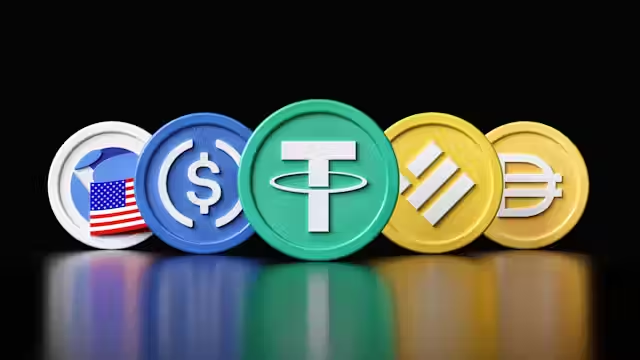
It’s a good week to be a string of alphanumeric symbols on a blockchain.
That’s because July 14th marks the start of what congressional Republicans are calling “Crypto Week,” a stretch in which lawmakers will vote on three key cryptocurrency bills designed to establish a friendlier regulatory regime for the digital asset industry. Among the legislation Congress is debating are the Senate’s Guiding and Establishing National Innovation for U.S. Stablecoins Act (GENIUS Act), which creates a new regulatory framework for stablecoins (cryptocurrencies whose value is tied to another asset or commodity, most frequently the U.S. dollar); the House’s Digital Asset Market Clarity Act (CLARITY Act), a broader market structure bill for the entire crypto industry; and the CBDC Anti-Surveillance State Act, designed to prevent the Federal Reserve from issuing digital currencies and monitoring private transactions on a publicly controlled ledger.
Proponents of cryptocurrencies, who argue that the crypto industry has been burdened with regulation that is both too heavy and too confusing, are applauding the light touch of this legislative push and the clarity it will provide for the digital asset economy. Opponents of cryptocurrencies, including those concerned by the public corruption implications of President Trump’s personal entry into the industry, have been trying to assess whether these extremely complicated bills—which are all more than likely going be passed this week—do enough to mitigate the numerous risks entailed in further integrating crypto into the financial system.
I’ve spent the summer working on lawsuits against crypto criminals for a cryptocurrency analytics firm that consults with law firms. For me, one issue in this legislation stands above all others in scope and urgency, especially because of its implications for financial crime: the regulation of stablecoins. So let’s look at this GENIUS Act.
What are stablecoins?
The main appeal of stablecoins is found in their name—stablecoins are more stable, i.e. less prone to market volatility, than popular traditional cryptocurrencies like Bitcoin or Ethereum. That’s because the value of a stablecoin is tied to that of an underlying asset, typically fiat currency. In the case of Tether and Circle, the two dominant stablecoin issuers in the United States, that underlying asset is the U.S. dollar. As the dollar strengthens, so do USDT and USDC, the stablecoins issued by Tether and Circle, respectively. As the dollar weakens, so do USDT and USDC.
The relative trustworthiness of stablecoins is theoretically a major plus for those trying to promote the digital asset industry as a whole as a reliable way to transact and invest. Stablecoins are seen as the gentler, less frightening way to convince skeptics to embrace decentralized finance more broadly. After all, the U.S. dollar is the most dependable and useful currency in the world. Demand for stablecoins (supply on blockchains worldwide currently totals over $200 billion) means demand—one-to-one—for U.S. debt, which strengthens dollar dominance in the global economy and benefits those seeking workarounds from strict capital controls or weak local currencies in developing countries (although tariffs would likely offset the benefits to USD strength by several orders of magnitude).
This all sounds very appealing. But big questions remain about how stablecoin issuers actually guarantee the value of their product. You might be wondering how the financial alchemy of pegging (or “tethering”) stablecoins to USD works. The answer is that stablecoin issuers are expected, basically, to hold US dollars in reserve, so that if a purchaser of USDT or USDC wants to cash in, they can be easily and quickly redeemed in USD. Ideally, the issuer will have enough in reserve to guarantee repayment in any instance, because “every penny” of crypto traded on blockchains will be accounted for in the issuer’s reserves (these reserves largely include short-term U.S. treasuries). In this sense, stablecoin issuers function very much like banks (with the notable exception that stablecoin issuers cannot pay interest to holders of its coins, a provision in the GENIUS Act).
But up until now, many in the crypto industry have had, we could say, serious reservations about these reserves. Tether is particularly notorious for the mysterious composition of its reserves, holding a mix of “cash, precious metals, commercial paper, and even crypto assets as backing.” Those assets, of course, are far more volatile and unreliable than USD, and many crypto users have been alarmed by Tether’s risky attitude towards reserve backing. Tether has gotten into trouble for this behavior in the past—in 2021, the Commodity Futures Trading Commission (CFTC) ordered Tether to pay a $41 million fine for misleading customers about the nature of its reserves and therefore misrepresenting the safety of deposits (Tether eventually settled for $18.5 million with the New York Attorney General).
On paper, the GENIUS Act appears to solve this problem. The bill imposes stringent 1:1 reserve requirements on stablecoin issuers and mandates that those reserves be composed exclusively of fiat USD, not other commodities or derivatives. The bill provides clarity, for the first time, on what federal regulators expect of stablecoin issuers when it comes to reserves, and provides mechanisms for enforcing the proper maintenance of these reserves through monthly reporting requirements, as well as audits for stablecoin issuers holding more than $50 billion of assets.
Again, on paper this looks like good, needed regulation—theoretically, these requirements would help ensure that regulators do not make the same mistakes in regulating stablecoin issuers that they did in regulating banks before the 2008 financial crisis. Indeed, much like the CDO-and-CLO-stuffed investment banks of pre-2008 (and now…) stablecoin issuers have heretofore been able to preserve an aura of elaborate mystery regarding their basic asset and liability sheets. This act, if enforced with teeth, would prevent that.
What the bill says
Let’s look into the bill in more detail. The Senate passed the GENIUS Act on June 17 by a vote of 68-30 (many Democratic Senators support crypto-friendly legislation and some on the Banking Committee count crypto industry figures among their top donors) and it will likely be passed this week by the House. The tldr (and it is tl, even if lawmakers will never admit that they dr) of the GENIUS Act is that it “creates a framework whereby stablecoin issuers under $10 billion would be regulated by states, and issuers over $10 billion regulated by the Federal Reserve or the Office of the Comptroller of the Currency.” The act basically regulates stablecoin issuers like banks, limiting what kinds of financial institutions can issue stablecoins and placing those entities under broader federal banking laws, including anti-money laundering statutes. It also provides definitional clarity that stablecoins will not be treated as securities (regardless of what one thinks about that notion…).
Again, the key provision of reserve requirements seems legit on first glance: reserves held by stablecoin issuers “must be held in safe assets, such as U.S. currency; bank deposits; deposits held at a Federal Reserve bank; Treasury securities with a maturity of 93 days or less; certain repurchase agreements backed by Treasuries; or money market funds that are invested in safe assets such as Treasuries or repos on Treasuries.” Those are all reliable assets, and in line with what banks are expected to keep in reserve.
There are also crucial requirements for what stablecoin issuers can do with those reserves (again, keep thinking about these companies as banks and analogize to the various investments banks can make with deposits). Under this bill, stablecoin issuers can only rehypothecate (meaning use collateral for one loan to finance another loan) assets for “limited purposes.” Issuers would be “restricted to using reserve assets for certain activities, including to redeem stablecoins and serve as collateral in repos and reverse repos.” But that might not be enough to prevent risky investment practices. For example, according to its S-1 filing, Circle currently holds 90% of its USDC reserves in the “Circle Reserve Fund,” a government money market fund managed by BlackRock. Circle acknowledged in that filing that “in extreme cases, the market for the short-dated U.S. government obligations held by the Circle Reserve Fund might not be sufficiently liquid for BlackRock to liquidate them in a way that allows us to meet redemption demands in a timely manner, which could potentially lead to redemption delays.” But the incentive structure created by the GENIUS Act might mean that those risks could crop up in cases that are less than extreme. An untold number of firms will enter the stablecoin market under these new guidelines, bringing competitive pressure against Circle (and Tether). This competition could increase risky practices, introducing more uncertainty to an already uncertain market (as a side note on the proliferation of new stablecoin issuers enabled by the bill, the STABLE Act, another stablecoin regulation bill proposed in the House, had slightly stricter requirements on federal versus state regulation and on what financial entities can register as stablecoin issuers).
Then there are the enforcement requirements. The bill requires that stablecoin issuers provide monthly updates on their reserves on their websites and, again, that those worth more than $50 billion be routinely audited by public accounting firms. The bill also applies the Bank Secrecy Act and Anti-Money Laundering statutes to stablecoin issuers. But the bill gets the casting all wrong when it comes to regulators, placing authority under, variously, the Federal Reserve, Office of the Comptroller of the Currency, the Secretary of the Treasury, the Treasury Financial Crimes Enforcement Network, and a newly created “Stablecoin Certification Review Committee.” Note the absence of the Securities and Exchange Commission in this regulatory regime (that securities definition revisits us)—under this regime, the SEC will have as little to do with digital asset regulation as its acronym-twin, the Southeastern Conference. A recent report by the newly formed Shadow SEC, an independent board of academics that comments on federal securities laws, observed that the Stablecoin Certification Review Committee, which the act creates to replace the SEC and CFTC as a stablecoin regulator, possesses “particularly unclear” powers. The Shadow SEC writes that “very little is set forth about this committee. Who is on it? What powers will it have? What regulations must it adopt, and what regulations will be discretionary for it, and within what limits? Is it subject to judicial review?” These are all important questions that the bill leaves unanswered.
Despite the weak enforcement mechanisms, this legislation might even have been a step in the right direction if it were not for a larger potential problem: a massive compliance loophole, either intentional or not, which could undermine the bill’s effectiveness.
The catch
Crucially, the GENIUS Act applies to domestically registered issuers of payment stablecoins. But it is unclear to what extent foreign-based stablecoin issuers will be required to comply with the same laws and expectations. Sec. 18 of the GENIUS Act outlines “exception[s] for foreign payment stablecoin issuers.” In other words, this section leaves the door open for stablecoin issuers to incorporate in foreign nations with different cryptocurrency laws and still operate legally in the United States, only provided that the Secretary of the Treasury determines, through an unclear process that includes a recommendation by the Stablecoin Certification Review Committee, that that country has a “comparable regulatory and supervisory regime” for stablecoins. Section 18(a)(3) goes on to make clear that “reciprocal” bilateral arrangements can be made between the U.S. and the foreign country to exempt stablecoin issuers incorporated there from abiding by GENIUS Act reserve and liquidity rules. What makes a regulatory and supervisory regime count as “comparable” is ambiguous. The regime must simply include measures “similar” to those in the GENIUS Act. Section 18 does not enlighten us as to what “similar” means.
This is a big problem. The biggest player in the stablecoin game is Tether, which is currently incorporated in famously crypto-friendly El Salvador. If the “comparable regimes” requirement is interpreted broadly—and we are entitled to the inference that it will be by an administration that is taking a largely laissez-faire approach to global financial crime—then it might be the case that Tether will not actually have to abide by the rules put forth in the GENIUS Act. Democratic Senator Jack Reed is concerned about this possibility, calling Tether “the biggest beneficiary of this bill.” He might be right (of course, Tether stands to lose from entry by new firms into the duopoly on the industry it shares with Circle). Despite claims that the GENIUS Act’s reserve provisions will require Tether to get its act together and clarify its deposit practices, Tether’s recent incorporation in El Salvador could make it formally exempt from many of these rules and functionally exempt from all of them, including the AML laws. If Secretary Bessent concludes that Salvadoran reserve requirements are “comparable” to those of the United States, Tether would be allowed to issue stablecoins to U.S. consumers while operating outside U.S. jurisdiction. You might be skeptical that the Treasury Secretary would define El Salvador as a third-party nation whose cryptocurrency laws are trusted by the United States. El Salvador has a virtually nonexistent regulatory regime for crypto and is notoriously trying to onshore crypto innovation by any means necessary. But there will be enormous political pressure on Bessent to do so due to numerous identifiable policy-warping corruption exposure risks in the administration. First, there is the fact that Tether’s banker, in charge of its Treasuries reserve, is investment firm Cantor Fitzgerald, which was run by Howard Lutnick before he became Commerce Secretary. This may create a Tether Lobby around the administration, pushing the president and Treasury Secretary to carve out exceptions for Tether. Second, there is the corruption risk of President Trump’s own cryptocurrency business interests, including a memecoin whose purchasers may include Salavdoran individuals and entities trying to influence the president. Third, there is the administration’s already demonstrated affinity for collaborating with El Salvador on violations of U.S. law, as seen in the Kilmar Abrego Garcia deportation case.
These factors alone are not enough to be certain that the vague language on extraterritoriality in the GENIUS Act will be good news for Tether, but it is enough for reasonable suspicion. These issues should be addressed on the House floor before the bill is passed and legislators concerned with these issues must receive compelling assurances before a vote is forced. Ultimately, the bill should include a rule on extraterritoriality before it is passed, as Benedikt Bartylla argued in April. Even if Tether refused to comply even with the laws that El Salvador does have, it could still issue USDT on decentralized exchanges, which are already the markets of choice used by many illicit actors. This is not okay. I agree with Senator Reed: “if someone is in the business of creating dollars in any form, they should be subject to full U.S. jurisdiction.”
The jury is still out on what will happen to Tether. The Wall Street Journal recently predicted that the biggest “loser” of the bill will be Tether, clearly assuming that the El Salvador workaround will not be permitted and that Tether’s reserve requirement compliance will need to shape up, or else the firm will be forced to reconstitute or exit the U.S. market altogether (it is currently reshaping its blockchain strategy, which is something to keep an eye on). Perhaps Tether really has changed—its CEO Paolo Ardonio certainly made Bambi-eyed gestures of compliance and conscientiousness on a lobbying trip to Washington a few months ago and also announced that Tether will issue a U.S.-only stablecoin later this year. These could be signs that the company is finally getting serious about its unlawful behavior and that it should in fact be worried about the GENIUS Act’s crackdown and the competitiveness the bill will unleash into the stablecoin industry. But its miserable record on transparency for the past decade does not give Tether the benefit of the doubt (in a June conversation, a prominent economist currently writing a report on stablecoins told me he believes Tether is and will remain a “con game”). Even if Tether issued a separate U.S. stablecoin and followed the GENIUS Act’s reserve requirements, it would still be allowed to issue its original coin, which remains the go-to cryptocurrency for the most wretched scum and villainy in the crypto world.
Risks and dangers
The best argument that can be made against the GENIUS Act as it stands is that even if there is just a small chance of Tether and other stablecoin issuers circumventing its laws through the extraterritoriality loophole, that risk outweighs the possible benefits of deregulating stablecoins in 2025. I’ve saved for last the absolute worst thing about stablecoins, a danger so extreme that much, much stronger legislation than the GENIUS Act will be required to address it: the facility with which criminals are able to use stablecoins to finance illicit ventures in human trafficking, arms dealing, terrorism, and other areas. In my summer work with the cryptocurrency analytics firm, which consults with law firms in class action lawsuits on behalf of victims of cryptocurrency confidence scams, the most common cryptocurrency token I have seen used by these scammers is USDT.
There’s good reason for this. One of the virtues of USD stablecoins is their easy convertibility. Crypto criminals wishing to have one-hop removed access to the world’s most useful sovereign currency choose USDT because it can so reliably and easily be exchanged for USD, which can then be laundered out of blockchains and into offshore bank accounts. USDT is also especially easily transferred to the blockchains most popular with crypto criminals (Ethereum and Tron) because of Tether’s long-standing lax approach to internal regulation, and is a “preferred vehicle” for cross-border payments, another plus for launderers.
There are multiple massive, multi-billion-dollar online scamming marketplaces (some of which were recently shut down) that basically run on USDT the way Boston runs on Dunkin’ and Olympus runs on nectar and ambrosia. USDT is the lifeblood of the $75 billion international cryptocurrency scamming industry, and its most ardent fans won’t look for alternatives unless they absolutely have to. Making it easier for Tether to enable what it enables is deeply dangerous, and even just the slightest risk that the GENIUS Act will do this gives me pause.
There are national security concerns, also. Convertibility and proximity to the USD also make stablecoins like USDT a popular cryptocurrency in countries facing U.S. financial sanctions. Many notorious regimes and non-state actors, from North Korea to Hamas, fund geopolitically dangerous and destabilizing programs partially through USDT, taking advantage of its useful attributes in complex laundering schemes. And while many citizens living under these regimes have also turned to stablecoins (and decentralized finance more broadly) as an escape valve, we have yet to fully consider the tradeoffs of allowing these private entities to introduce vast quantities of US debt to these markets. It may be “dollarization by code,” but it is also dollarization by companies (i.e. not the government), and that undeniably creates potential vulnerabilities for our national security, because what’s good for General Motors is, it has been established, not always good for America.
Don’t get me wrong—we need a federal bill for stablecoins. Because the asset is so new and has existed in the wilderness for so long relative to other cryptocurrencies, we do not yet have a comprehensive and uniform federal regulatory regime for it, and that is unsustainable. But this is not the bill we need. Properly regulated, stablecoins might have the capacity to provide needed liquidity to money markets, strengthen U.S. national security, and provide a bulwark against other unstable features of the global financial system. But the GENIUS Act is not proper stablecoin regulation and, as written, will not achieve these things. Instead, if the bill allows Tether to get away with noncompliance, it will strengthen the worst aspects of the cryptocurrency industry at a moment that other deregulatory market structure legislation is facilitating the integration of crypto into the financial system, multiplying the risks of overexposure to volatile crypto. The GENIUS Act may unlock stablecoins’ power as “demand engines” for U.S. debt but it will expose our financial system to numerous hazards in the process.
If the Treasury Secretary identifies El Salvador as a “comparable” regulatory regime for digital assets to the United States, then the GENIUS Act will have rewarded Tether’s hostility towards U.S. regulatory jurisdiction itself. The bill provides no meaningful protections against the massive and ever-growing crypto scam industry, which is largely run through USDT and affects thousands of Americans across the country every year, many of whom lose their life savings to these scams (and under the bill USDT could still even be traded within the United States on decentralized, or partner-to-partner, exchanges). What I have learned in my summer work is that extraterritorial jurisdiction is the most significant challenge for those trying to bring crypto criminals to justice or otherwise clean up the crypto economy. The major compliance arm-twisting required to successfully bring civil forfeiture lawsuits for laundered crypto needs to be done against cryptocurrency exchanges, many of which are located outside the United States and believe themselves to be immune to the mandates of US legal jurisdiction. Treating foreign-based stablecoin issuers like these exchanges and even allowing Tether, the major player in the space, to operate outside the United States is a disastrous course of action to take when it comes to protecting our jurisdictional legitimacy over financial transactions relying on our own currency.
Finally, for obvious reasons, we should not trust a politician who is himself in the stablecoin industry—the Trump family’s World Liberty Financial recently started issuing a stablecoin called USD1—to pass legislation for the purpose of responsibly regulating the stablecoin industry (would we have trusted Donald Trump with writing the real estate laws in New York in the 1970s?). USD1 is being minted on the anonymous Tron blockchain, which hosts more illicit crypto activity than any other blockchain. Tron is also a popular blockchain for Tether, and the GENIUS Act won’t stop that.
by Zachary Partnoy


