
The Lemur is publishing a selection of the most original, compelling, and persuasive final op-eds written in Fall 2025’s Public Policy 301: Political Analysis for Public Policy-Making, taught by Dr. Deondra Rose.
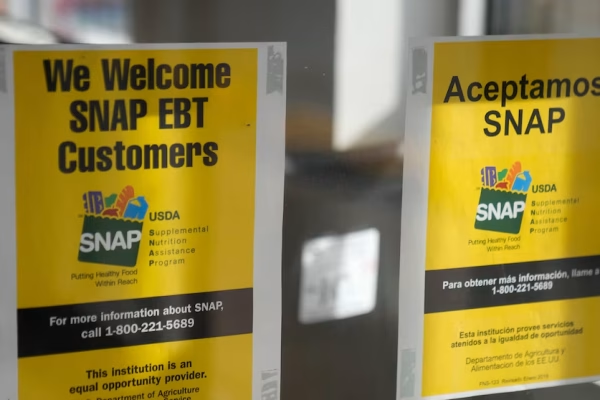
Knowing the distinct look of the blue EBT card my mom concealed while paying for groceries showed me how one swipe could provide so much. Whether it was milk, rice, or maybe a small treat like boxed cereal if we were lucky, SNAP helped us put food on the table when we needed it the most. Yet this November, overflowing lines were seen outside food pantries nationwide: parents with strollers, elders with fold-up chairs, and children waiting. Food insecurity had become part of a political agenda, with millions who were able to rely on SNAP (Supplemental Nutrition Assistance Program) a month prior fearing going hungry.
SNAP benefits have never been a luxury; they are how 41.7 million Americans put food on the table. The 43-day government shutdown froze November SNAP benefits, leaving benefits delayed. Meanwhile, Immigration and Customs Enforcement (ICE)’s annual budget hit a record high of $28.7 billion. The increased budget combined with the present anti-immigrant political agenda is causing the number of deportations to rise, arrests to become more ruthless, and deportation centers to increase their capacities. If we can fund large enforcement budgets, we can fund, protect, and prevent programs like SNAP from budget cuts and freezes.
SNAP funding isn’t safeguarded, so when shutdowns, political deadlock, and temporary spending bills arise, their effects spill over into household fridges. The failure to protect SNAP funding is not a resource issue but a congressional choice that threatens social safety nets and exposes top government’s priorities that put enforcement efforts on a pedestal. This isn’t just a hiccup in U.S bureaucracy, it’s a pattern caused by years of flawed design. Every few years, programs like SNAP, WIC, and the Child Tax Credit are played like poker chips, waiting for legislative budget decisions. In 2024, Senate allowed the expanded Child Tax Credit to expire during budget negotiations. Had they chosen to protect it, 3 million children would have stayed out of poverty. Nonetheless, if lawmakers started to prioritize constituent supported social programs, the first cuts would affect over-funded enforcement agencies.
SNAP’s new non-citizen eligibility requirements paired with high ICE’s presence, have brought disproportionate harm, stripping an estimated 250,000 refugees and other non-citizens of their benefits permanently. Expanded enforcement has bled into families’ tables through SNAP’s stricter eligibility. So, when food access shrinks at the same time enforcement expands, food insecurity becomes a direct product of federal choices, not a lack of money.
Struggling families become disposable when SNAP is put on the line and ICE’s large budget, funded by the “One Big Beautiful Bill Act,” proved to us that billions can be spent to enforce racial profiling and criminalization, but not a fraction of effort to fund and safeguard government programs.
Although some argue that cutting SNAP benefits help government spending goals, SNAP is one of the highest return on investment federal programs, generating $1.54 in economic activity per $1 spent. SNAP stabilizes local economies, unlike deportation buses or empty detention center beds that produce profit for private companies and harm our labor markets. If concern is government waste, the real waste are enforcement budgets that positive value and don’t keep families safe or fed.
Food access shouldn’t expire every time Congress can’t agree on a budget. Congress needs to ensure that SNAP is fully protected from future government budget conflicts by treating SNAP like Social Security and decoupling it from budget debates, while also considering possible funding safety nets. State congressional leaders can also expand emergency food services and work to realign and reestablished their state budget priorities to prioritize initiatives that positively impact communities and their needs. At a personal level, we can volunteer at our local food and national pantries and organizations like Feed America or the Salvation Army, and we can fundraise and hold lawmakers accountable on election days. Hunger is not inevitable, but our government has the power to provide us resources, and we have the power to influence them.
As someone who benefitted from SNAP, I know how much stability those benefits can provide families. Families shouldn’t have to witness Congress prioritize politics over their next meals. SNAP helps keep families rooted in their communities, communities that deserve protection, not political manipulation. Our budget priorities should reflect the values of the communities we feed, not the profits of the agencies people fear. The argument is clear: if our leaders can fund fear, they can fund stable protected food solutions.
by Citlalli Alaniz
Citlalli Alaniz is a sophomore at Duke University, majoring in Economics and Public Policy.


